A Tally Prime with GST course teaches you to run a business’s books inside Tally Prime: creating ledgers, entering vouchers, managing stock, recording GST on purchases and sales, deducting TDS, and reading the reports an accountant or owner checks every month. The courses worth paying for pair each software step with the accounting rule behind it, so you know why an entry goes where it goes and not just which key to press.
We have taught Tally at our Baguiati centre since 2001, and this guide draws on the same syllabus, examples and mistakes we deal with in class. It is written for students, jobseekers, working accounts staff and small-business owners in Kolkata who want to know what the training covers, what employers will expect afterwards, and how to pick the right course before paying for it.
A full course covers accounting fundamentals, company setup, ledgers and vouchers, banking and bank reconciliation, inventory and orders, cost centres and budgets, GST and TDS entries, financial reports, data security and year-end work. At Shashank Skills Academy, a Tally Education Authorised Training and Assessment Partner, this training runs through our Tally centre, Tally Institute of Learning in Baguiati, as a classroom course or an online course, with certification issued directly by Tally. Both need 10+2 in any stream, and no prior accounting study.
What Tally Prime does in an accounts office
Tally Prime is accounting and business-management software from Tally Solutions, launched in 2020 as the successor to Tally.ERP 9. Shops, traders, distributors, manufacturers and CA firms use it to record sales, purchases, payments and stock, to handle GST and TDS, and to produce statements like the Balance Sheet and Profit and Loss account. If you still see “Tally ERP 9” in an old job post, the employer almost always means the same kind of work.
You will meet four terms on day one:
- Ledger: an account for one customer, supplier, bank, expense or income head, where every related transaction lands.
- Voucher: the screen you use to record one transaction, such as a payment, a receipt or a sale.
- Inventory: the goods a business buys, stores and sells, tracked item by item.
- Bank reconciliation: matching the bank entries in your books against the bank statement and explaining why they differ.
The software does the arithmetic and keeps the records in order. It does not decide which ledger an expense belongs to, whether a sale is inter-state, or whether a supplier’s invoice qualifies for tax credit. Those calls come from accounting and tax knowledge. A course that only teaches keystrokes leaves you stuck the first time a real entry does not match the textbook.
Why learn GST inside Tally Prime
GST applies to most purchases and sales a registered business makes in India, so almost every invoice an accounts assistant enters carries tax. Reading the GST rules tells you what should happen. A Tally Prime with GST course shows you where the GSTIN goes, how the tax splits on an invoice, and how each entry feeds the GSTR-1 and GSTR-3B reports the business uses for its returns.
Example: CGST, SGST or IGST?
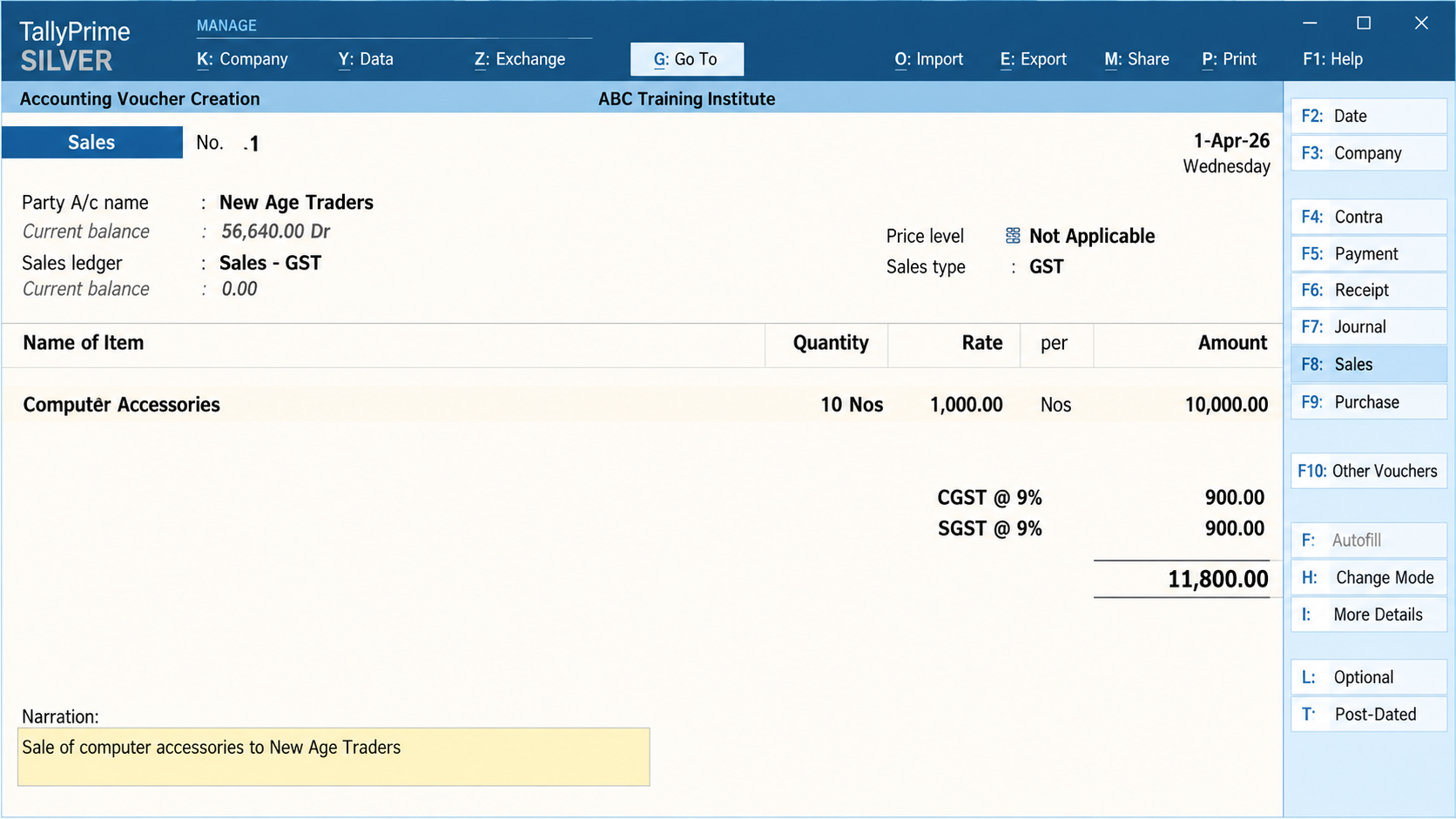
A Kolkata trader sells goods worth ₹10,000 to a customer in West Bengal, and the item attracts 18% GST. Because the sale stays within the state, Tally Prime splits the tax into ₹900 CGST and ₹900 SGST, and the invoice total becomes ₹11,800. Sell the same goods to a buyer in Odisha and the software charges ₹1,800 IGST instead. Tally picks the right split from the state in the party’s ledger, so a wrong state in one master record produces wrong tax on every invoice that follows.
Example: input tax credit and the monthly payment
In one month, the same trader buys stock worth ₹50,000 from a West Bengal supplier and pays ₹4,500 CGST and ₹4,500 SGST on it. Sales for the month come to ₹80,000, which carry ₹7,200 CGST and ₹7,200 SGST. The tax paid on purchases is input tax credit, and it is set off against the tax collected on sales:
| CGST | SGST | |
|---|---|---|
| Tax on sales (output) | ₹7,200 | ₹7,200 |
| Tax on purchases (input credit) | ₹4,500 | ₹4,500 |
| Net tax payable | ₹2,700 | ₹2,700 |
Tally Prime works this out from the vouchers you entered. Your job is to make sure every purchase was entered with the supplier’s GSTIN and the right tax ledgers, because a purchase entered wrongly shows no credit, and the business pays more tax than it owes.
E-invoicing and why it matters for your first job
Businesses with an aggregate annual turnover above ₹5 crore must generate e-invoices for B2B sales, with an Invoice Reference Number and QR code from the government’s registration portal. Businesses with turnover of ₹10 crore and above must report each invoice within 30 days of issuing it. Tally Prime can generate e-invoices from the sales voucher itself. If your first job is with a mid-sized distributor or manufacturer, you will likely use this feature from the first week.
GST rates, thresholds, return forms and filing rules change through notifications. The figures in this article were checked in September 2026. A course teaches you how the software handles GST. For a live business decision, check the current rule on the official GST portal or with a qualified tax professional.
The syllabus, level by level, with worked examples
A well-built Tally Prime with GST course moves from accounting basics to daily transactions, then to stock and control features, and finishes with tax and year-end work. Our classroom programme follows the TallyEssential curriculum from Tally Education, which is split into three levels. Each level ends with a business case study.
Level 1: accounting and core Tally Prime
You start with the fundamentals of accounting, including the golden rules and double entry, before touching the software. Then you create a company, build the chart of accounts with ledgers and groups, and record the eight core voucher types: payment, receipt, contra, journal, purchase, sales, debit note and credit note.
Level 1 also covers banking. Here is a typical reconciliation exercise. Your books show a bank balance of ₹1,20,000, but the bank statement shows ₹1,45,000. The difference is a ₹25,000 cheque you issued to a supplier on the 28th that the supplier has not yet deposited. In Tally Prime you mark each cleared entry with its bank date, and the uncleared cheque stays visible as the reason the two balances differ. Students who learn this properly can explain any gap between books and bank, which is exactly what a senior accountant will ask them to do.
The level closes with financial statements and MIS reports (Trial Balance, Balance Sheet, Profit and Loss, Cash Flow, Day Book, ratio analysis), user roles and data security, and backing up and restoring company data.
Level 2: inventory, receivables and controls
Level 2 adds stock. You set up stock items, groups and units, handle purchase and sales orders, and track extra purchase costs. Say a furniture dealer buys 100 chairs at ₹800 each and pays ₹2,000 freight to bring them to the shop. With additional cost tracking, Tally Prime loads the freight onto the stock, so each chair costs ₹820 in the books and the profit on every sale is accurate.
You also manage receivables and payables with bill-wise details, so you can see exactly which invoices a customer has not paid and for how long. Cost and profit centres let a business with two shops, say one in Baguiati and one in New Town, see income and expenses for each shop separately from the same set of books. Budgets let the owner set a monthly limit for heads like rent or travel and compare it against actual spending.
Level 3: GST, TDS and year-end
The final level covers Goods and Services Tax and Tax Deducted at Source inside Tally Prime. On the GST side, you enable GST for the company, set up tax ledgers and item rates, record GST purchases and sales, and review the GST reports. On the TDS side, you learn how deduction works on payments. For example, a business pays a chartered accountant ₹60,000 in professional fees during the year. That crosses the ₹50,000 annual threshold for professional services, so the business deducts TDS at 10%, pays the CA ₹54,000, and deposits the ₹6,000 with the government.
From April 2026, the new Income-tax Act, 2025 replaced the old section numbers such as 194C and 194J with a single table, while the rates in examples like this one stayed the same. You will still hear the old numbers in offices for a while, so it helps to know both.
Level 3 finishes with managing business data and moving the company into the next financial year, carrying closing balances forward so the new year starts from the right figures.
Skills you practise in class
By the end of a Tally Prime with GST course, you should be able to do these tasks on your own, at a steady pace:
- Create a company and set up its ledgers, groups and stock items under the correct heads
- Enter everyday vouchers and correct a wrong entry without breaking the books
- Record GST sales and purchases and check the CGST, SGST or IGST split on each invoice
- Reconcile a bank account and explain every difference
- Track outstanding bills for customers and suppliers, invoice by invoice
- Deduct TDS on a payment and record it correctly
- Read a Trial Balance, Balance Sheet, Profit and Loss account and Day Book, and spot an entry that looks wrong
- Back up, restore and protect company data with user roles
Speed and confidence come from repetition. Students who run the case-study transactions more than once, on their own, handle a job interview test with far less stress than those who only watched it done.
Seven mistakes beginners make in Tally Prime
These are the errors our faculty correct most often in the lab. Each one looks small on screen and causes real trouble in a business’s books.
- Putting a ledger under the wrong group. Create “Shop Rent” under Indirect Incomes instead of Indirect Expenses and the Profit and Loss account shows a profit that does not exist. The fix is to learn the group structure before creating ledgers, not after.
- Charging CGST and SGST on an inter-state sale. This almost always traces back to a wrong or missing state in the party ledger. Checking the state while creating the ledger saves hours of corrections later.
- Entering a purchase without the supplier’s GSTIN. The entry looks complete, but the input tax credit does not match what the supplier reported, and the business can lose that credit.
- Using a journal voucher for everything. A sale entered as a journal does not appear in the sales register or GST reports. Each transaction has its own voucher type for a reason.
- Recording sales without stock items. When inventory is switched on, a sale entered only in rupees leaves the stock reports showing goods that were already sold.
- Leaving bank reconciliation for months. After three months, nobody remembers why a ₹4,000 entry does not match. Reconciling every month keeps the gaps small and explainable.
- Never taking a backup. One corrupted data folder can wipe out a year of entries. Backup and restore is a Level 1 topic because it matters from the first day of real work.
What a Tally practical test in an interview looks like
Many employers hiring for accounts roles give candidates a short practical test at a computer instead of only asking questions. Formats vary, but a common one runs like this:
- Create a new company with GST enabled.
- Create ledgers for a few customers, suppliers, a bank and some expenses, under the correct groups.
- Enter 10 to 15 transactions from a sheet, including GST purchases and sales, a payment, a receipt and a contra entry.
- Show the Trial Balance or Profit and Loss account.
- Explain one entry: why you debited this ledger and credited that one.
The last step is where many candidates fail. They can enter the voucher but cannot explain the logic behind it. In our Tally Prime with GST course, the business case studies at the end of each level are the same kind of work as this test, and the accounting fundamentals taught at the start are what let you answer the “why” question.
Tally is rarely the only thing employers check. When our placement team speaks with hiring companies about freshers, they keep hearing the same extra asks: Excel for data entry and MIS reports, clear email writing, confidence on client calls, spoken English, and the ability to use AI tools for everyday office work like drafting emails. Plan to build these alongside Tally.
Jobs that use Tally Prime and GST every day
This training prepares you for entry-level roles where most of the day is spent inside accounting software:
- Accounts assistant or junior accountant: daily voucher entry, bank reconciliation, supplier and customer ledgers.
- Billing executive: raising GST invoices, e-invoices and credit notes, and tracking payments against them.
- GST or tax assistant at a CA firm: entering client data, preparing figures for returns, and reconciling purchase records with supplier data.
- Stores and inventory accounts clerk: stock entries, purchase orders and stock reports for traders and manufacturers.
- Accounts executive in a small business: handling the whole cycle from invoice to monthly report, often as the only accounts person.
Starting pay depends on the employer, the city area and what else you bring, such as Excel and communication skills, so treat any single salary figure you see online with caution. Growth in these roles usually comes from moving into GST return work, finalisation of accounts and team supervision.
Who should enrol
A Tally Prime with GST course suits anyone whose work touches a business’s money records. The learners we see most often fall into five groups:
- B.Com and other college students who want a practical skill on the CV alongside the degree. Starting in the second year gives time to add GST and Excel before graduation.
- Fresh graduates and jobseekers aiming for the accounts, billing and tax-assistant roles listed above.
- Career changers moving into accounts from sales, retail or office support.
- Working staff who already enter bills but learned on the job and want the full picture, including GST, TDS and reports.
- Small-business owners who want to read their own books and check what their accountant prepares.
You do not need prior accounting study. The course starts with accounting fundamentals, and the minimum eligibility is 10+2 in any stream. Arts and science students join regularly and cope well, provided they spend extra time on the golden rules in the first few weeks.
Classroom or online: two ways to learn with us
Shashank Skills Academy runs its Tally training through Tally Institute of Learning, Baguiati, our Tally Education centre on VIP Road near the 44 Bus Stand. You can take the course in one of two formats:
| Classroom (Baguiati) | Online | |
|---|---|---|
| Course | Tally Essential | TallyPrime with GST |
| Duration | 3 levels, 3 classes a week of 2 hours | 35 hours |
| Covers | Levels 1 to 3, including inventory, orders, cost centres, budgets, GST and TDS | 9 modules: accounting basics, core Tally Prime, banking, reports, data security and GST |
| Support | Faculty in the lab, business case studies after each level | Weekly 45-minute live doubt-clearing session |
| Study material | Text material with explainer videos, quizzes and infographics | Text material with explainer videos, quizzes and infographics |
| Certificate | Issued and verified by Tally Education | Issued and verified by Tally Education |
| Placement | Lifetime access to Tally’s placement portal, plus our placement assistance | Lifetime access to Tally’s placement portal |
| Eligibility | 10+2, any stream | 10+2 |
The classroom route goes deeper. It suits learners who want inventory, cost control and TDS practice with a trainer checking their work. The online route suits people outside Kolkata or those with fixed working hours who mainly need accounting and GST in Tally Prime. See the Tally Essential classroom course in Baguiati or the TallyPrime with GST online course for current fees, batch timings and the full module list.
What to learn after Tally Prime
Tally Prime is the base of an accounts career. After a Tally Prime with GST course, most students add one or two skills on top, depending on the job they want:
- For GST return work: a dedicated GST course covers the law, the portal and the returns in more depth than a Tally course can.
- For income tax and TDS returns: the e-Filing course moves from entering TDS to filing it.
- For MIS and reporting roles: our Advanced Excel course covers the lookups, pivot tables and reports that most accounts offices build from Tally data.
- For a complete accounts career track: the Diploma in Computerized Financial Accounting combines Tally with the other job skills in one longer programme.
How to choose a Tally course in Kolkata
Kolkata has many Tally classes, and they vary a lot in depth. Before you pay for any Tally course, ask these questions:
- Is the syllabus written down? A module list you can read before joining is a good sign. “Tally with GST” on a banner tells you nothing.
- Is the centre a Tally Education Training and Assessment Partner? Ask who issues the certificate. A certificate from Tally Education carries weight with employers. One printed by the institute itself does not.
- Are the trainers certified? Ask whether the faculty hold Tally Certified Trainer status.
- Will you enter transactions yourself? Watching a trainer’s screen is not practice. Ask how much lab time you get and whether there are case studies.
- Does the course go past GST billing? Inventory, bank reconciliation, TDS and year-end work all come up in real jobs.
- Does the timetable fit your life? Check weekday and weekend options, and whether an online format exists if you travel.
- What happens after the course? Ask plainly what placement help means at that centre. No honest institute can promise a job.
Direct Tally certification at our Baguiati centre
Here are our own answers to the checklist above. Shashank Skills Academy has trained students since 2001, and its Tally centre, Tally Institute of Learning, Baguiati, is an Authorised Training and Assessment Partner of Tally Education, the education arm of Tally Solutions. The academy holds ISO 9001:2015 certification, and our trainers are Tally Certified Trainers.
We are the only institute in the Baguiati area that offers direct certification from Tally Education. Most other institutes in the locality issue their own certificates, which Tally neither issues nor recognises. Our students also get lifetime access to Tally’s own placement portal.
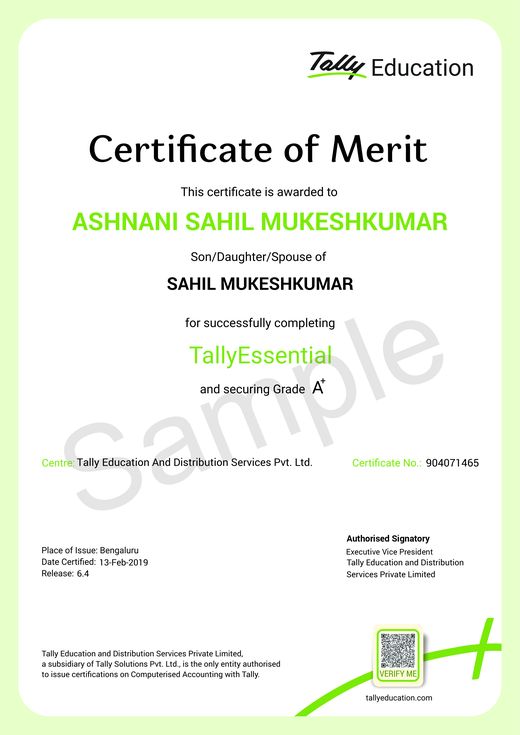
Being an Assessment Partner matters for you as a student. Your final assessment follows Tally Education’s standards, and the certificate you receive is issued and verified by Tally itself. An employer anywhere in India can check it, which is not possible with a certificate printed by the institute that taught you.
More than 7,500 students have trained at the Tally centre. Tally Education has recognised the academy with its Placement Champ award and the Rising Star award (East Zone). Former students work at organisations including Deloitte, PwC and Bandhan Bank, as well as with many Kolkata businesses and CA firms.
Students get placement assistance, free soft-skills training and lifetime access to Tally Education’s own placement portal, where employers who hire Tally-certified candidates post openings. Placement assistance means we help with interview preparation and connect you with hiring companies. The job itself depends on your skills and how you perform in the interview.
Frequently asked questions
Do I need to know accounting before learning Tally Prime?
No. Both our classroom and online courses begin with the fundamentals of accounting. If you studied commerce, the first few classes will feel like revision, and that revision helps when the software work starts.
Is Tally ERP 9 still worth learning?
Learn Tally Prime. It replaced Tally.ERP 9, and the accounting concepts are the same, so someone trained on Tally Prime can work on an older ERP 9 setup with little adjustment. The reverse is harder, because the screens and navigation changed.
Does a Tally course guarantee an accounting job?
No course can guarantee a job. Tally training gives you a skill employers test for. Getting hired also depends on your interview, your Excel and communication skills, and the role’s requirements.
Should I take a GST-only course instead?
A GST-only course focuses on the tax law, the portal and the filing process. A Tally Prime with GST course teaches the whole bookkeeping job with GST built into it. If you are new to accounts work, start with Tally. If you already use Tally daily and want to handle returns, a GST course is the logical next step.
Is this useful if I run a small business?
Yes, for understanding your own books. You will learn how sales, purchases, stock and tax entries fit together, and how to read the reports your accountant sends. For tax filing and compliance decisions, keep working with a qualified professional.
Can I learn from outside Kolkata?
Yes. The online TallyPrime with GST course is open to learners anywhere in India and includes a weekly live session for doubts.
Is the certificate issued by Tally?
Yes. As a Tally Education Authorised Training and Assessment Partner, we offer direct certification from Tally. You receive a digital certificate issued and verified by Tally Education, which an employer can check online. In the Baguiati area, we are the only institute that offers this. Other local institutes issue their own certificates, which Tally does not issue or recognise.
Your next step
Pick a format for your Tally Prime with GST course first. If you live near Baguiati and want supervised lab practice through all three levels, including inventory and TDS, the classroom course fits. If you need flexible hours or live outside the city, go online.
Still unsure which one suits your goal? Book a free 1-on-1 counselling session, and our counsellor will look at your background, your timetable and the kind of job you want before suggesting a course.
Course details and tax figures on this page were last checked on 28 September 2026.
Sources and further reading
- GST Portal, Government of India, for registration, returns and official notices
- CBIC GST site, for GST rates, Acts and notifications
- GST e-invoice system, for e-invoicing rules and the Invoice Registration Portal
- Income Tax Department, for current TDS rates under the Income-tax Act, 2025
- Tally Solutions guide to e-invoicing rules