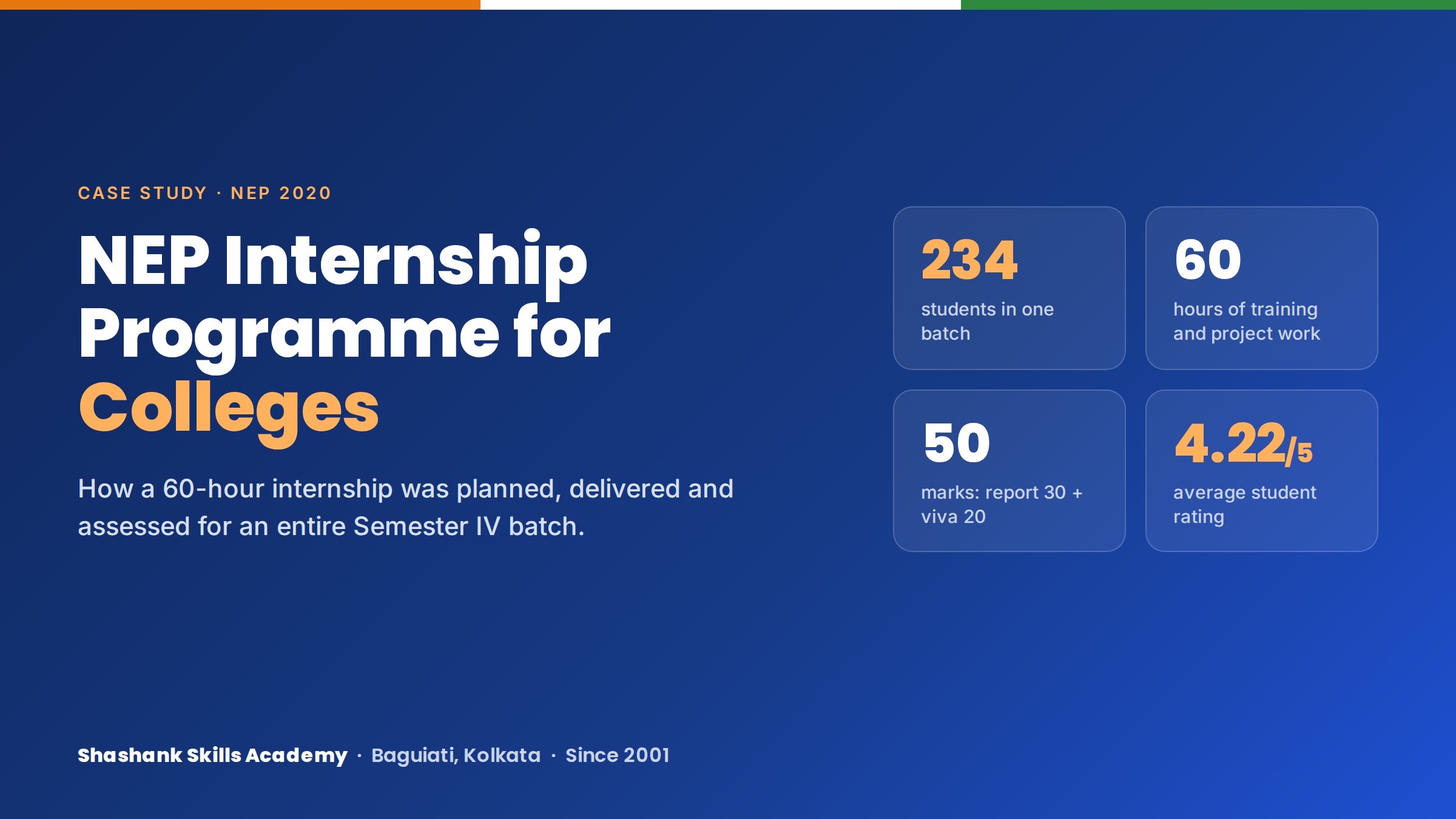
An NEP internship programme for a college has to do four things at once: give every student real, supervised work for the required hours, end in a project report and viva the university will accept, keep attendance and marks records the college can show at audit, and run for 100 or 200 students without taking over the college’s own timetable. In June 2026, we ran a 60-hour NEP internship for 234 Semester IV students of Mrinalini Datta Mahavidyapith, a WBSU-affiliated college. This article explains what the rules ask of colleges, how we built and assessed that programme, what the students told us afterwards, and what to ask any provider before you sign.
It is written for principals, IQAC coordinators and the faculty members who have been handed the internship file and need a workable plan.
Under the UGC’s 2023 guidelines, undergraduate students in the NEP framework complete an internship of 60 to 120 hours, usually after the fourth semester, carrying 2 to 4 credits. A college can partner with an external organisation through an MoU to deliver it. Shashank Skills Academy designs and runs these programmes for whole batches, on campus or in blended mode, with daily attendance records, guided mini projects, a report and viva assessment, and certificates for every student.
What NEP 2020 asks colleges to deliver
The UGC’s Guidelines for Internship and Research Internship for Under Graduate Students, finalised in 2023, set the national frame. The points that matter most for a college planning a batch are these:
- Hours and credits: 2 to 4 credits are assigned to the internship, with 60 to 120 hours of engagement. One credit equals roughly 30 hours.
- Timing: the internship sits after the fourth semester, at the end of the second year.
- Who can host it: other institutions, research labs, companies, industry, government offices and local businesses. The guidelines ask colleges to sign MoUs with these partners.
- Supervision: a nodal officer arranges the opportunities, an internship supervisor monitors and evaluates each student, and a mentor guides the student’s work.
- What students do: hands-on training, a short project, seminars, field study of an enterprise or social project. Internships can be individual or in groups.
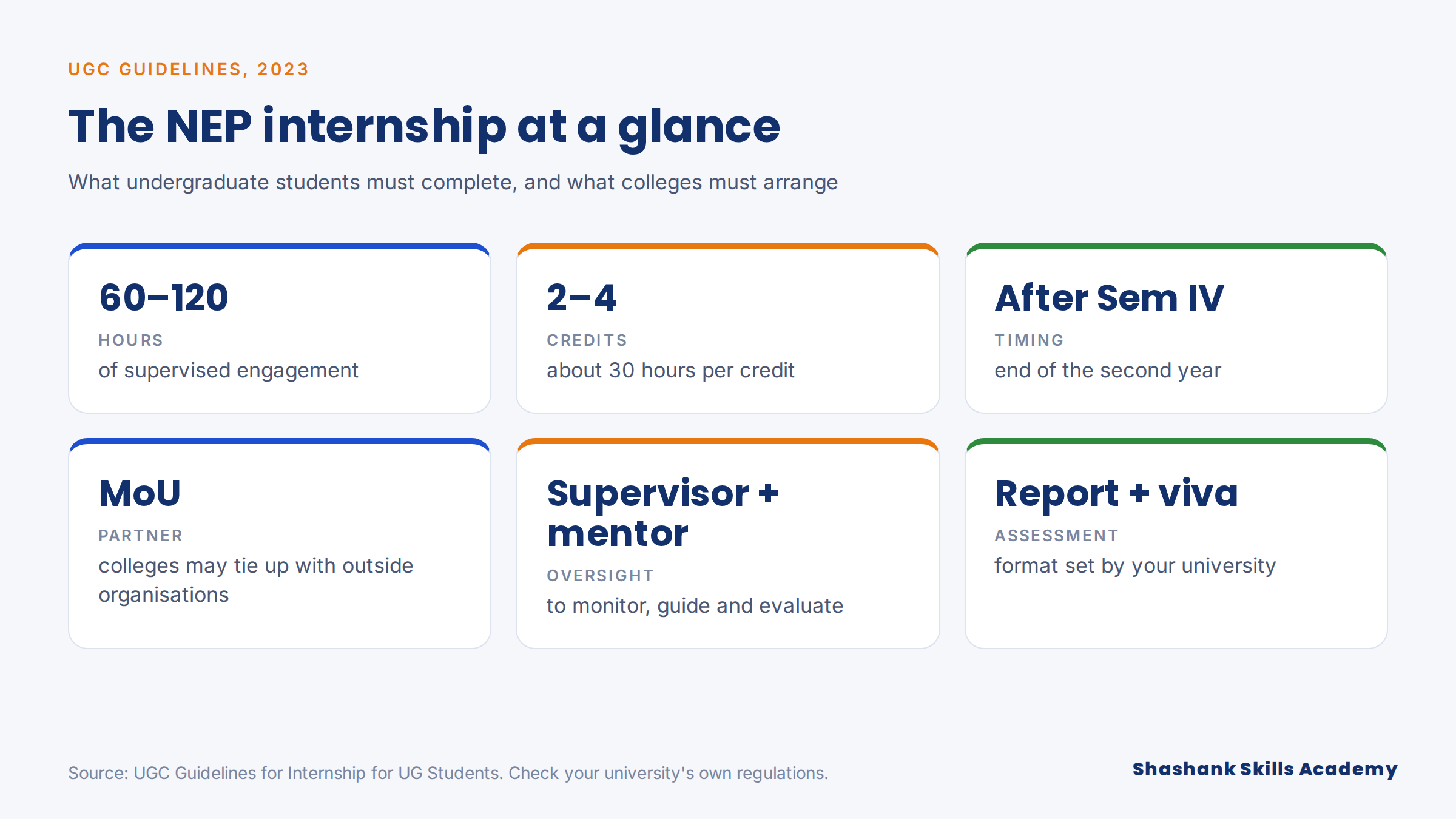
Each affiliating university then fits this into its own curriculum. West Bengal State University’s NEP structure for B.Com, for example, lists the internship as a 4-credit, 50-mark component, with internship slots placed after Semesters II, IV and VI. The University of Calcutta assesses its internship through a report and a viva. The marks split, the paperwork and the deadlines differ from one university to the next.
Read your own university’s current NEP regulations and circulars before fixing the hours, marks and assessment format. An internship is assessed as work done and reported on. A programme that is only a set of lectures, with no project or report, may not meet what your university expects.
Why a large batch is hard to manage in-house
Finding one internship for one student is easy. Finding 60 supervised hours for 234 students, in the same two weeks, is a different problem. When we speak with principals and internship coordinators, the same five difficulties come up:
- Placement capacity. Local businesses can take two or three interns each. Nobody can take 200.
- Faculty time. Teachers already carry full timetables, exam duty and NAAC work. Supervising 200 projects on top of that rarely gets done well.
- Relevance for arts and commerce students. Many available internships suit science or management students. B.A. students in particular get left with token assignments.
- Records. The university, the IQAC and later the NAAC team all want attendance, hours, reports and marks for every student, kept in one place.
- Assessment. Reading 200 reports and holding 200 vivas within the university’s deadline needs planning from the first day, not the last week.
A partner who brings trainers, content, a project framework and a record system takes most of this load off the college while the college keeps control of approval and final marks.
Case study: 234 students at Mrinalini Datta Mahavidyapith
Mrinalini Datta Mahavidyapith, a college in Birati affiliated to West Bengal State University, Barasat, needed to run the internship for its entire Semester IV batch. The college signed an MoU with Shashank Skills Academy, and together we ran the 60-Hour Internship Programme on Digital Employability Skills, Artificial Intelligence and Emerging Technologies.
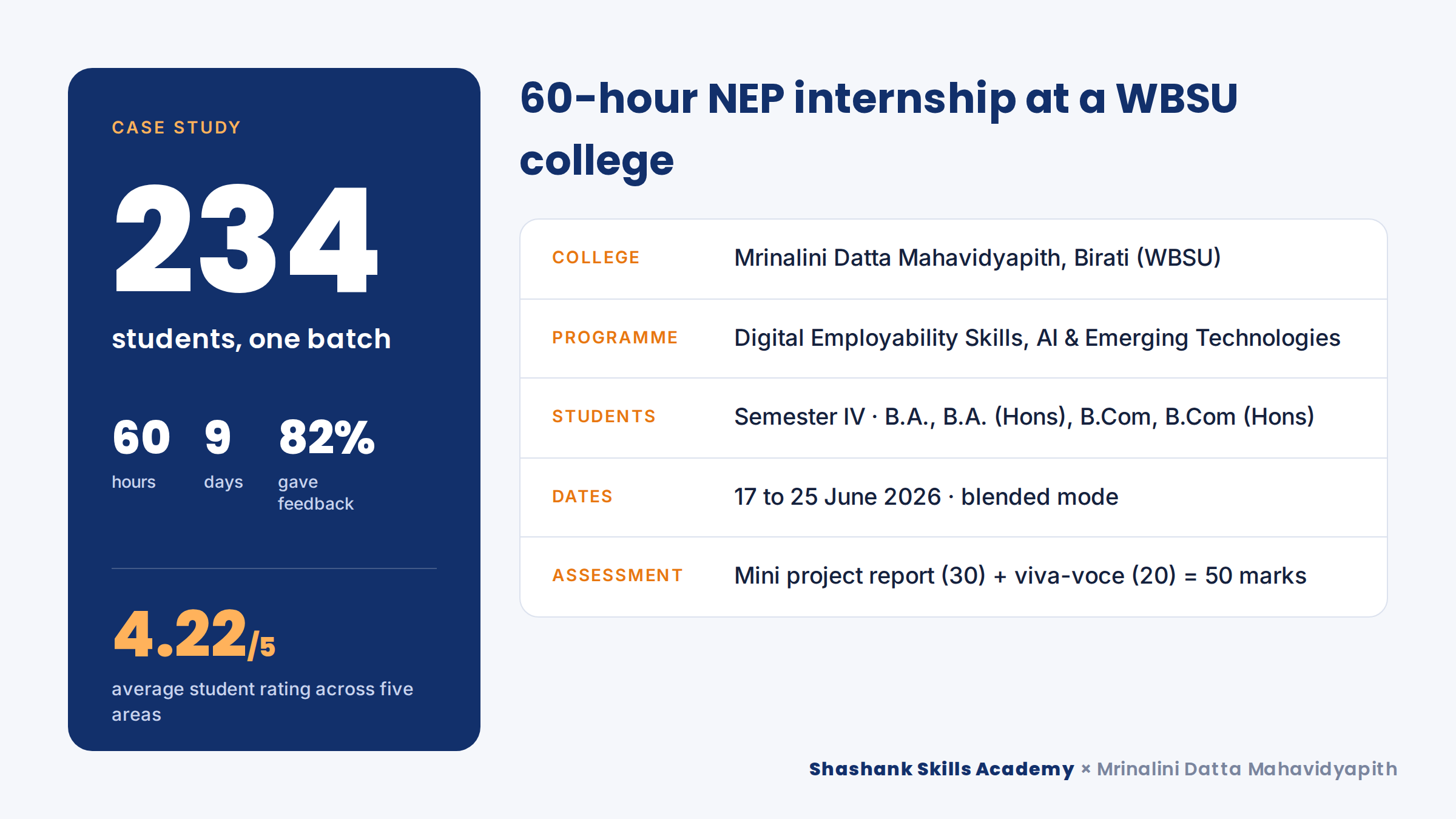
| College | Mrinalini Datta Mahavidyapith (affiliated to WBSU, Barasat) |
| Programme | 60-Hour Internship Programme on Digital Employability Skills, Artificial Intelligence and Emerging Technologies |
| Students | 234, Semester IV: B.A., B.A. (Honours), B.Com and B.Com (Honours) |
| Dates | 17 to 25 June 2026 |
| Mode | Blended (offline and online) |
| Assessment | Internship mini project report (30 marks) and viva-voce (20 marks), total 50 marks |
What the 60 hours covered
Most of the batch were B.A. students, so we built the content around skills any graduate uses at work, whatever their subject. The sessions covered:
- Artificial intelligence for everyday work: using AI tools to research, draft and organise, and understanding their limits.
- Emerging technologies and cybersecurity: how these technologies show up in workplaces, and how to stay safe online.
- MS Excel and basic data analysis: organising data, simple formulas and reading a summary.
- Graphic design with Canva: making posters, social media posts and simple presentations.
- Tally and GST basics: an introduction to how businesses keep accounts, useful for commerce and arts students alike.
- Spoken English and workplace communication: introducing yourself, emails and speaking with confidence.
Each day had a participant handbook in English and Bengali, so students could revise at home in the language they were most comfortable with. Trainers stayed available on a batch WhatsApp group between sessions, which students later named as one of the things they valued most.
The project, the report and the viva
Training alone does not make an NEP internship programme complete. Alongside the sessions, every student worked on a mini project and wrote it up using a report template we provided, with a worked sample report to show the expected depth. Trainers guided the projects through the programme, not just at the end.
Assessment took place at the college on 25 June 2026. Each student submitted the project report, marked out of 30, and faced a viva-voce, marked out of 20, for a total of 50 marks. Attendance was tracked for every student across all eight days, including assessment day, so the college had a complete record for its university submission.
What the students told us
At the close of the NEP internship programme, we ran a structured feedback survey. 193 of the 234 students responded, a response rate of about 82%. They rated five areas on a scale of 1 to 5 and answered two open questions. We reported every response to the college, and we share the results here the same way, including the weak spots.
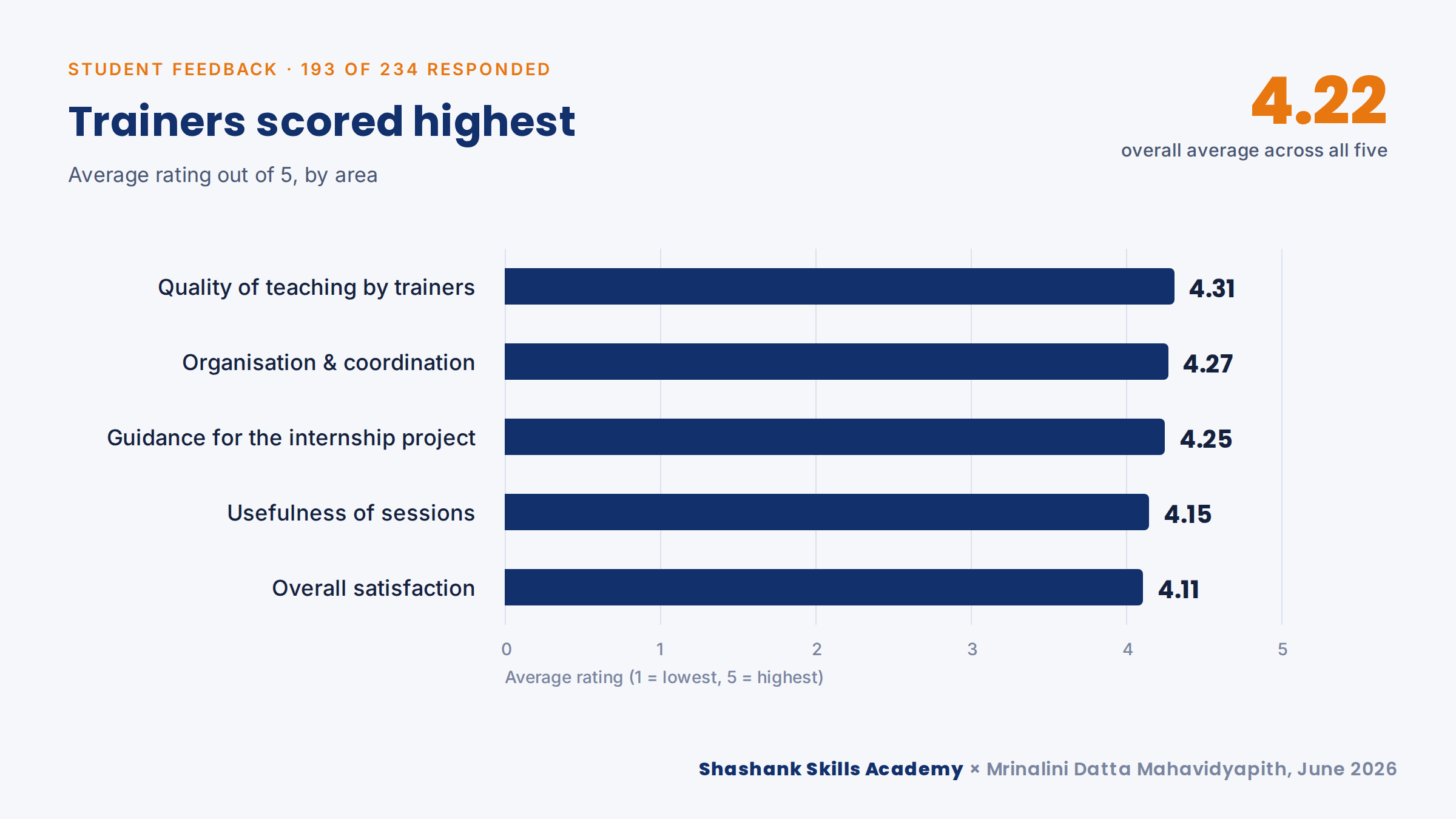
| Area rated by students | Average (out of 5) | Rated 4 or 5 |
|---|---|---|
| Quality of teaching and guidance by trainers | 4.31 | 80% |
| Organisation, communication and coordination | 4.27 | 83% |
| Guidance for the internship project | 4.25 | 80% |
| Usefulness of sessions | 4.15 | 75% |
| Overall satisfaction | 4.11 | 75% |
| Average across all five | 4.22 |
Students most often valued practical, job-relevant skills and the confidence that came with them (53 mentions), followed by patient and responsive trainers (29) and their first real exposure to AI and emerging technologies (27). Canva and graphic design (19) and Excel (18) were the tools named most.
What did not go as well
About 10% of respondents were dissatisfied overall, and 14 students rated every area low. The improvement requests were consistent: more hands-on practice and live projects (22 mentions), more interactive sessions (20), and more time, because many felt 60 hours was packed for so many topics (17). A few asked for more computer-lab time and for sessions with people from industry.
We took three changes from this into future programmes: fewer topics covered in more depth, a larger share of lab and project time, and short breaks between back-to-back sessions. For colleges that can spare the time, we now also suggest spreading the 60 hours over more days.
Three in four students were satisfied or very satisfied, and trainer quality scored highest. The main request was for more of the same: more practice, more projects, more time. That points to the model working, with room to deepen it.
How we run an NEP internship programme with a college
Every college has its own university rules, calendar and student mix, so each programme starts with a planning meeting with the principal and the internship coordinator. From there, the work follows six steps:
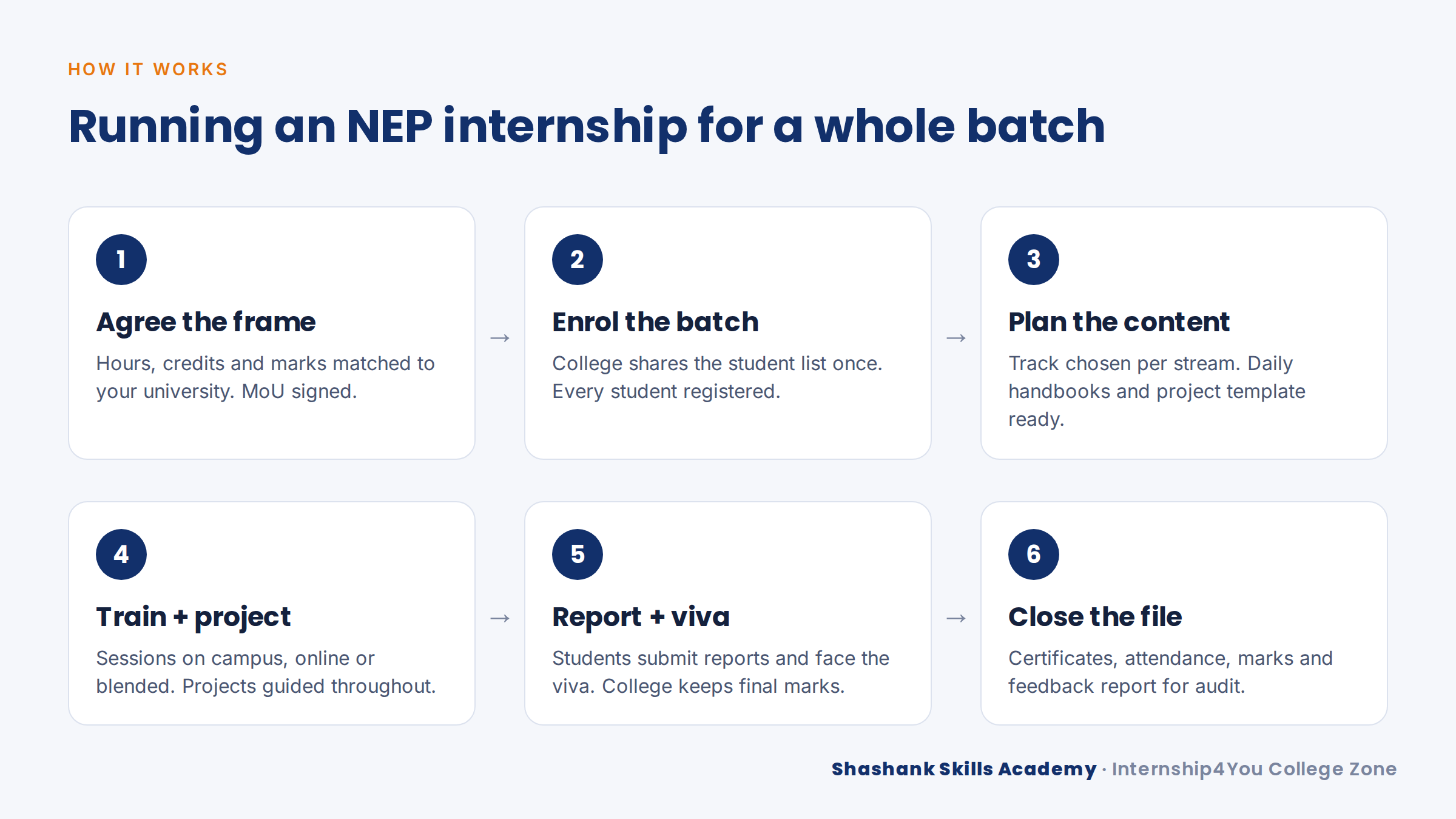
- Agree the frame. We match the hours, credits, marks split and assessment format to your university’s regulations, then sign an MoU.
- Choose the domain. Pick one track for the whole batch, or different tracks for commerce, arts and science students.
- Enrol the batch. The college shares the student list once, and we register every student.
- Deliver. Classes run on your campus, at our Baguiati centre, online or in a mix, with handbooks for every day and project guidance throughout.
- Assess. Students submit their reports and appear for the viva on a date agreed with the college. The college keeps final authority over marks.
- Close the file. Every student receives a certificate, and the college receives attendance records, marks and a feedback report for its university and NAAC documentation.
Colleges manage all of this through the College Zone on Internship4You, our NEP internship portal. It handles bulk enrolment from a CSV file, tracks attendance, hours and completion as the programme runs, generates certificates when students finish, and produces compliance reports for university submission and NAAC. Each partner college also gets a dedicated coordinator from our Baguiati centre.
Internship domains we offer
Colleges can choose the Digital Employability Skills and AI programme described above, or a focused track that suits a particular stream:
| Track | Topics | Suits |
|---|---|---|
| Accounting | Tally Prime, GST, Income Tax | B.Com, BBA |
| Office Suite | MS Office, Advanced Excel, Power BI | All streams |
| Graphics | Graphic design, UI/UX design | B.A., all streams |
| Web | Web design, web development, digital marketing | All streams |
| Coding | C/C++, Java, Python, PHP/MySQL, data science, AI and ML | B.Sc, BCA |
Arts-heavy batches usually do best with the employability and AI programme or a graphics track, where students produce visible work for their reports. Commerce batches often prefer accounting, because the project ties directly to the jobs most of them will apply for.
Questions to ask any internship provider
Whichever organisation you consider for your college’s NEP internship programme, ask these questions before signing:
- Have you run a batch of our size before? Ask for the number of students, the college and the dates.
- Is there a project and report, or only classes? Ask to see the report template and a sample report.
- Who supervises the projects? Ask how many trainers will guide how many students.
- Will the format match our university? The provider should adapt hours and marks to your regulations, not the other way round.
- What records do we receive? Attendance, hours, marks and certificates for every student, in a form you can submit and file.
- Will you share honest feedback? A provider that reports only the good scores is not giving you the full picture.
- What are the provider’s credentials? Check how long they have trained students and which bodies recognise them.
Our own answer to the last question: Shashank Skills Academy has trained students in Baguiati since 2001 and holds ISO 9001:2015 certification. We are an authorised Skill India BFSI training partner under NSDC, an Authorised Training and Assessment Partner of Tally Education, and an MoU partner of the Technology Innovation Hub at IIT Guwahati (IITG TIDF). Through our college partnership programme, we also work with colleges including Derozio Memorial College, Sarojini Naidu College for Women and East Calcutta Girls’ College.
Frequently asked questions
Will the programme count for our students’ internship credits?
Credit is awarded by your university, through your college. We design the hours, project, report and viva to match your university’s regulations, and the college approves the plan before it starts. That is how the Mrinalini Datta Mahavidyapith programme was set up for WBSU’s 50-mark internship component.
What is the smallest or largest batch you can take?
We have run a single programme for 234 students. Smaller batches are simpler to schedule. For very large batches, we split students into groups with separate session times.
Do classes happen at the college or at your centre?
Either, or both. The Mrinalini Datta Mahavidyapith programme ran in blended mode, with the assessment held at the college. Colleges with a computer lab often prefer on-campus sessions, and students asked for more lab time in their feedback.
Can B.A., B.Com and B.Sc students be in one programme?
Yes. The June batch mixed B.A. and B.Com students, General and Honours. We chose topics every stream could use and let students pick project subjects related to their own discipline.
What does it cost the college?
Cost depends on batch size, hours, track and venue, so we quote after the planning meeting. There is no setup cost to register on the College Zone.
Plan your college’s internship
The earlier you start, the easier the assessment week will be. Give yourself at least a month between signing the MoU and the first session, so the schedule, handbooks and project template are ready before students arrive.
To plan the next NEP internship programme for your students, register your college on the Internship4You College Zone, and our coordinator will contact you to set up a planning meeting.
Regulations referred to on this page were last checked on 14 October 2026.