The computer syllabus by board looks identical on a school timetable but differs sharply on the exam paper. A CBSE student in Class 9 or 10 works with office tools and HTML. An ICSE student of the same age, by contrast, writes Java programs. For West Bengal board students we teach Classes 9 and 10 from the school’s own computer book, and the board-set subjects, Computer Science (COMS) and Modern Computer Application (COMA), begin in Class 11.
Parents usually ask one thing first: what will my child be tested on in computers? The answers below come from each board’s own syllabus documents, read directly where the board’s site allowed, so the marks, the practical work and the date we checked are all stated.
Written by the Shashank Skills Academy Editorial Team. Last updated 29 October 2026. We read the CBSE 2026-27 documents for Classes 9 and 10 and the West Bengal Council of Higher Secondary Education (WBCHSE) syllabus documents on the update date. Boards revise their syllabi, so check your child’s current circular as well.
The short answer and a note on accuracy
CBSE Classes 9 and 10: Computer Applications (code 165), half theory and half practical. In Class 10, HTML alone carries 25 of the 100 marks. ICSE Classes 9 and 10: Computer Applications taught through Java, with programming assignments for Internal Assessment. West Bengal board: the school’s own book up to Class 10, then COMS or COMA in four semesters over Classes 11 and 12. Your child’s school decides which subject is offered, so confirm it with the school.
This comparison is general guidance. It summarises board documents as we last checked them, and the last section gives the date for each board. Boards revise syllabi, and schools choose their own subjects, textbooks and internal assessments, so the official board circular and your child’s school always come first. Shashank Skills Academy is a computer training institute. It is not part of CBSE, CISCE or WBCHSE, and this page is not an official board publication. If you find an error, tell us and we will correct it.
The three boards in Classes 9 and 10, side by side
Start with the table, because it shows the computer syllabus by board for Classes 9 and 10 at a glance.
| Board | Subject | Built around | How the marks split |
|---|---|---|---|
| CBSE | Computer Applications (code 165), session 2026-27 | Class 9: IT basics, cyber safety, office tools. Class 10: networking, HTML, cyber ethics | 50 theory and 50 practical in both classes |
| ICSE | Computer Applications | Java programming from Class 9 | Written paper, plus programming assignments for Internal Assessment |
| West Bengal board | We teach from the school’s own computer book in Classes 9 and 10 | Whatever the school’s book covers | Set by the school |
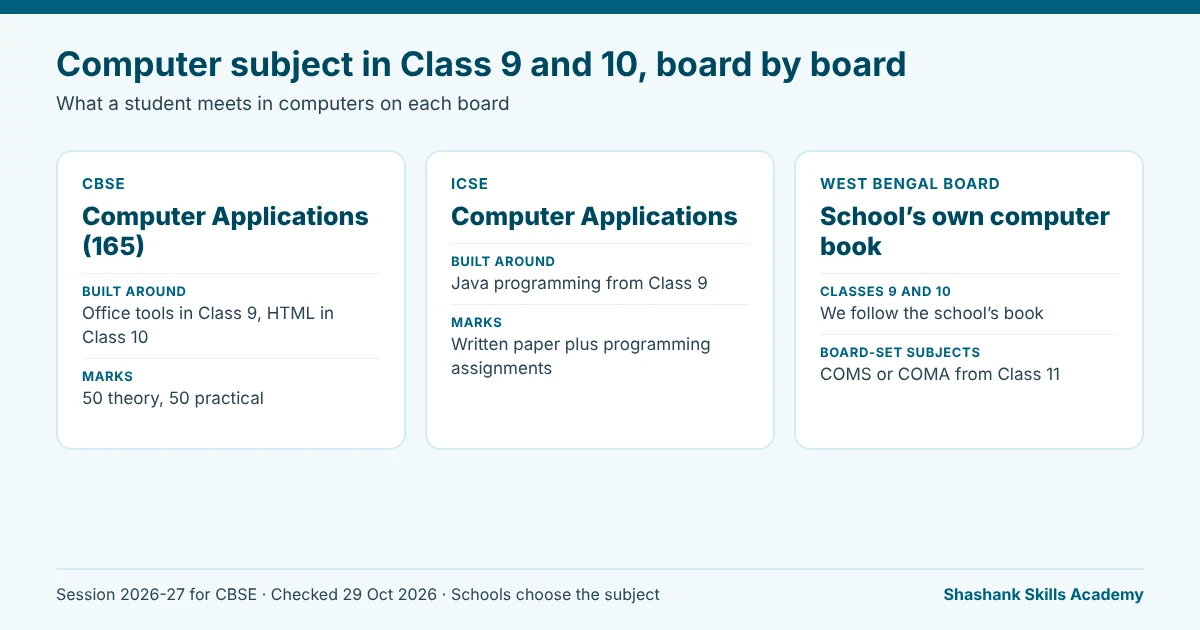
The pattern is simple. CBSE rewards practical file work, ICSE rewards the ability to write code, and the West Bengal board subjects we cover start in Class 11.
CBSE: half the marks come from practical work
CBSE’s 2026-27 curriculum gives Class 9 Computer Applications 100 marks, split 50 for theory and 50 for practical. The theory units are Basics of Information Technology (20 marks), Cyber Safety (15) and Office Tools (15). The practical unit, Lab Exercises, carries the other 50.
In the computer syllabus by board for CBSE, those 50 practical marks divide into a lab test of 30 (10 each for word processing, spreadsheets and presentations), a report file with viva worth 10 (8 for the file, 2 for the viva) and a project worth 10.
Class 10 changes the subject, so the weights shift. Networking carries 15 marks, HTML 25 and Cyber Ethics 10, with 50 practical marks on top. The lab test, worth 20, is a single web page designed from a diagram. The report file needs at least 10 HTML pages and earns 15, the viva adds 5, and the project is worth 10.
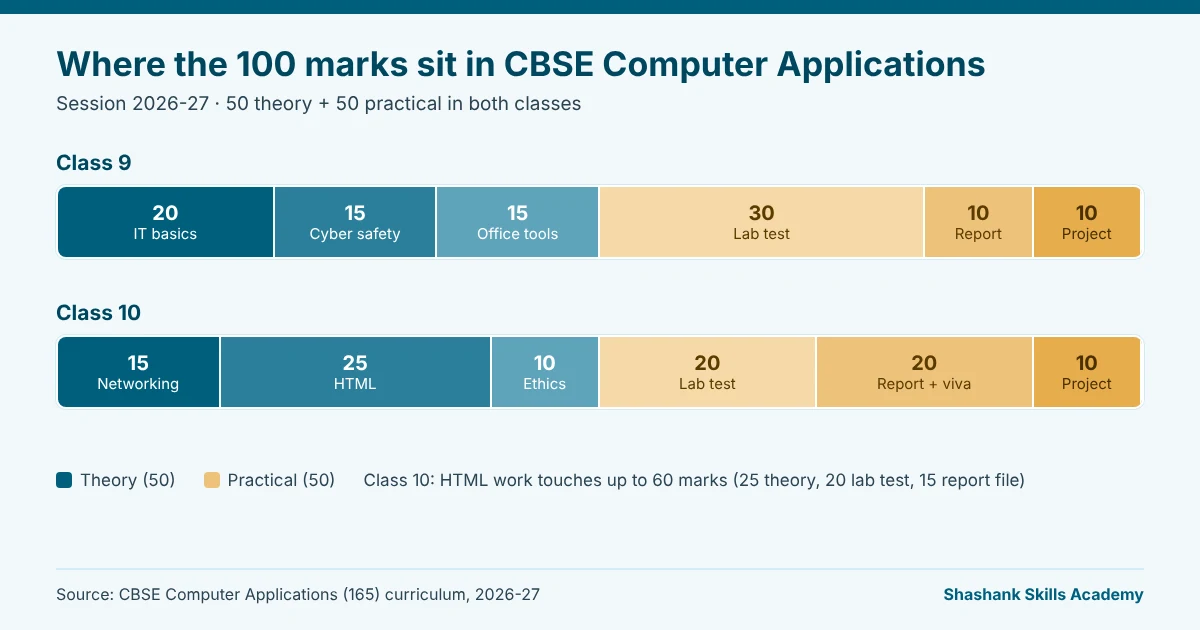
Add it up and HTML touches up to 60 of the 100 Class 10 marks: 25 in theory, 20 in the lab test and 15 in the report file. A student who has only read about tags loses marks in the lab test, because the page has to be built from a diagram on the day. So writing one small page a week from the start of the year fixes this.
Our CBSE computer tuition page lists the units class by class, including Computer Science and Informatics Practices for Classes 11 and 12.
ICSE: the subject is Java from Class 9
In the computer syllabus by board, ICSE schools use the name Computer Applications too, but the subject is Java. Class 9 covers ten topics: object oriented programming concepts, objects and classes, values and data types, operators, input in Java, mathematical library methods, conditional constructs, iterative constructs, nested for loops, and computing and ethics.
Class 10 builds directly on Class 9. Its eight units are a revision of Class 9, classes as the basis of computation, user-defined methods, constructors, library classes, encapsulation, arrays and string handling.
Besides the written paper, students complete programming assignments for Internal Assessment. They must write and run those programs themselves, because the school and the examiner check them. In our view this is where ICSE students slip. Constructors, arrays and strings in Class 10 all assume fluency with classes and methods, so a student who skipped the Class 9 programs feels the gap within a term.
Our ICSE and ISC computer tuition page has the full topic lists, including ISC Computer Science for Classes 11 and 12.
West Bengal board: where the board-set subjects begin
For Classes 9 and 10 we teach from the school’s own computer book. The board-set computer subjects we cover begin in Class 11, where WBCHSE offers Computer Science (COMS) and Modern Computer Application (COMA). Both run in four semesters across Classes 11 and 12, and each semester has a 35-mark theory paper. Your child’s school decides which of the two it offers, so the computer syllabus by board for Class 11 depends on the school as much as the board.
| Semester | COMS | COMA |
|---|---|---|
| I (Class 11) | Computer System and Organisation (15), Programming Fundamentals (10), Introduction to C (10) | Computer System and Organisation (15), Programming Fundamentals (10), Data Visualization using Spreadsheet (10) |
| II (Class 11) | Data Structure (15), Computer Networks (10), Ethics (10) | Data Structure (10), Computer Networks (15), Ethics (10) |
| III (Class 12) | Python Programming (25), E-Commerce (10) | Python Programming (25), E-Commerce (10) |
| IV (Class 12) | Database Management System (20), Foundation of Artificial Intelligence (15) | Basic of Operating System (10), Database Management System (15), Foundation of Artificial Intelligence (10) |
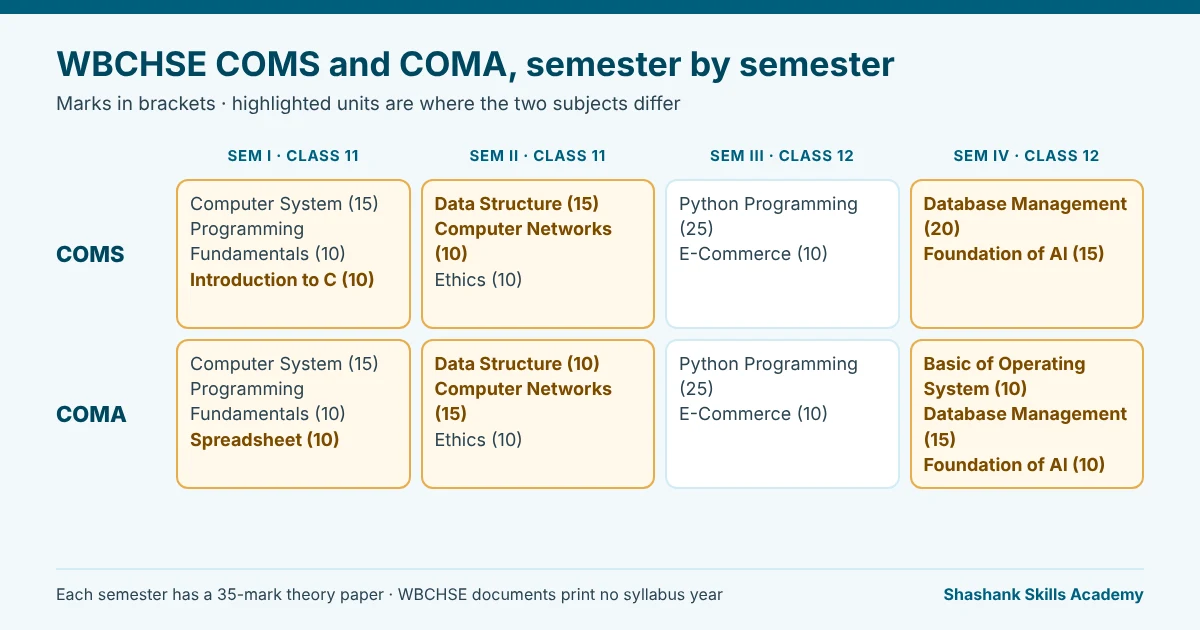
Both subjects share Semester III, but the biggest difference sits in Semester I. COMS teaches C in Class 11 and Python in Class 12, so a student learns two languages in two years. COMA swaps C for spreadsheets, and the spreadsheet unit gets 50 of the 100 theory contact hours listed for Semester I. As a result, a COMA student weak in spreadsheets loses ground fast in the first term.
Our West Bengal board computer tuition page covers both subjects, and we teach in English, Hindi or Bengali, whichever your child follows best.
Classes 11 and 12 on CBSE and ISC in brief
The computer syllabus by board gets heavier in Classes 11 and 12. CBSE offers Computer Science (083) and Informatics Practices (065). Both use Python and SQL. Computer Science goes deeper into programming, with Computer Systems and Organisation and Computational Thinking and Programming in Class 11, then programming, Computer Networks and Database Management in Class 12. Informatics Practices leans toward data instead, with Python, Pandas and SQL.
ISC Computer Science also continues the Java route. The Class 12 theory paper has three sections: Boolean algebra and computer hardware, Java topics including recursion, and then inheritance, interfaces, polymorphism, data structures and Big O notation.
What every board repeats
Ethics appears on all three boards under different names: Cyber Ethics in CBSE Class 10, Computing and Ethics in ICSE Class 9, and Ethics in the WBCHSE Class 11 syllabus. Networks also follow the same pattern, with Networking in CBSE Class 10, Computer Networks in CBSE Class 12 and Computer Networks in WBCHSE Class 11.
So a child who changes board or school does not start from zero. Ethics and networking carry over. Still, the big shifts are the language of choice, which is HTML on CBSE, Java on ICSE, and C then Python in WBCHSE COMS, and how much of the grade depends on practical work.
When tuition helps and when school lessons are enough
Knowing the computer syllabus by board also shows where tuition helps. School lessons are enough when the school runs regular lab periods and your child writes and runs something every week. Tuition helps instead when practical work is the weak link: CBSE’s 50 practical marks, ICSE programming assignments, or COMA’s spreadsheet unit.
Try a quick test at home. Ask your child to do one task without help: build a one-page HTML file for CBSE Class 10, write a Java program with a loop for ICSE, or sort and filter a table in a spreadsheet for COMA. If the task goes smoothly, school lessons are working. But if your child stalls, the gap is worth fixing before the exam year.
How computer tuition runs at our Baguiati centre
We teach computer to school students from Class 4 to Class 12 for CBSE, ICSE and ISC, and the West Bengal board. Classes follow your child’s own school syllabus and chapter order, rather than a separate course of ours.
- Classes are in person at our Baguiati centre only. We do not run school computer tuition online.
- Batches usually have 4 to 6 students, depending on the slot.
- A student attends 2 days a week for 1 hour each, or 1 day a week for 2 hours, any day from Monday to Sunday, subject to availability.
- Fees start from ₹1,000 per month and are subject to change, so ask for the current fee.
- Chayan Mitra, MCA, with 10+ years of teaching experience, takes the classes for all three boards.
We do not run routine demo classes because most slots are full. Visit the centre with your child at H/H-7, Aswininagar, VIP Road, near 44 Bus Stand (map), and a counsellor will check the free slots. The computer tuition hub page links to all three board pages, or book a counselling session or use the contact page.
How we checked this comparison
A page about the computer syllabus by board needs honest dates. Different parts of this page were checked at different depths, and we would rather say so than leave you guessing. We also list each source below.
- CBSE Class 9 and Class 10 Computer Applications, session 2026-27: opened and read on 29 October 2026 (Class 9 document and Class 10 document).
- WBCHSE COMA and COMS: opened and read on 29 October 2026 (COMA syllabus and COMS syllabus). Neither prints a syllabus year.
- ICSE, ISC and CBSE Classes 11 and 12: summarised from the board documents we reviewed while building our tuition pages. We did not reopen them on 29 October 2026, so confirm exact topics with the school or on the CISCE website and the CBSE curriculum page.
Schools choose their own subjects, books and internal assessments, and boards revise syllabi, so the circular your child’s school received is the final word. If anything here looks out of date, write to us through the contact page and we will check it and update the page.